Volume 3 Issue 1 of Al-ʿILM
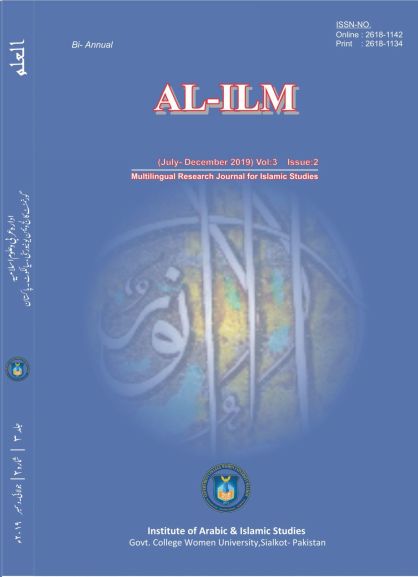
Journal
Al-ʿILM; العلم; Al-ILM
Editor
Dr Syeda Sadia
Publisher
Institute of Arabic and Islamic Studies, GCWU, Sialkot Pakistan
ISSNP
2618-1134
ISSNE
Institute of Arabic & Islamic Studies, Govt. College Women University, Sialkot. Pakistan
Frequency
Biannual
Article Processing Charges
none
Submission Charges
none
Journal Start Date
2017
Review Process
Double Blind Peer Review
Subjects
Comparative Religion; Islamic Studies.
Languages
Arabic; Urdu; English
Editorial Board URL
Aims URL
Author Instructions URL
Author Licence URL
Open Access
Yes
ARI Id
1682060040263
Analysis of Rights of Foetus in the Light of Searah Nabviyah: Comparative Study With Positive Law
The article titled: the rights of foetus in Islamic law, aims at explaining the rights of foetus without discussing different theories of the scholars in this regards. It also defines the foetus and gives literal and technical meanings besides different stages of foetus mentioned in the Holy Quran and the Hadith. The article explains the rights granted to foetus in the lights of serah before birth and these rights are a binding on the concerned people and violation of foetus’ s rights is prohibited and it is a cognizable offence. The article also discusses the attitude of west regarding foetus rights as the western society is totally ignorant about the rights of foetus and their legislation in this regard is contrary and several western laws are causing the violation of foetus’s rights. Thus, the champions of human’s rights are blind to the rights of foetus which is foundation and beginning of human life and first step for the human race. It is that has given these rights to mankind for the first time and informed human being about their rights through the first human’s rights charter given at the time of the Noble Prophet {blessing of Allah and peace be upon him}. This charter is known as the charter of Madina between the Muslims and the Jews. The article concludes: mankind cannot be protected unless the sperm of man is protected and foetus is protected in the womb of the mother from abortion because these are the future of humanity.
The Impact of Prophetic Hijrah on the Societies of Makkah and Madinah
The aim of Hijrah is philosophically viewed as a way to spread Islam wisely. This was by Allah’s guidance and directive amidst the very bitter atmosphere in Makkah at that time against the early followers of the Islamic religion brought by the Rasulullah (pbuh). The prophetic Hijrah observed from the way it impacted Makkah and Madinah’s societies can be construed as a very important event that provided us with a variety of messages. It also acts as a reflection of our contributions to da’wah and the roles we can assume as good Muslims, by looking at what the Rasulullah (pbuh) and his companions had themselves sacrificed in the Hijrah. In short, Al-Hijra is the time when the Prophet Muhammad (pbuh) and his followers moved from Makkah to Madinah, where they set up the first Islamic state. Islam needed to expand and spread in the world, so the migration resulted in the expansion and preservation of Islam and Muslims. The Rasulullah (pbuh) migrated to Madinah when his enemies in Makkah mistreated him and his followers. It is a fact that the early Muslims in Makkah were greatly troubled by the unbelievers of Quraisy, the tribe of the Prophet (pbuh). The Rasulullah’s (pbuh) popularity in his da'wah efforts to invite his people to Islam was seen as threatening by the people in power in Makkah. The context of Hijrah was seen as urgent and timely as the unbelievers in Makkah had escalated the persecution against Muhammad (pbuh) and his followers. This persecution and a directive from Allah were the main reasons for the migration.
النظرية الدينية لفکر الإرهاب الدولي في ضوء السيرة النبوية
It is an undoubted fact that terrorism has nothing to do with Islam. All teachings of the Prophet (blessings and peace be upon him) are contrary to any kind of extremism, radicalization and terrorism. Although the Prophet (blessings and peace be upon him) and his Companions faced injustice, persecution and terrorism directly by the disbelievers of Mecca and were forced to leave their homeland, yet, they always treated very peacefully and never demonstrated any kind of extremism. When the Prophet (blessings and peace be upon him) established the first state of Islam in Medina, it faced many atrocities and conspiracies by its enemies, but Muslims never chose the path of injustice and terrorism even against its worst enemies. Muslims always preferred peace treaties and covenants with everyone, so that people can live peacefully. The life of the Prophet (blessings and peace be upon him) is a practical model of moderation, integration and harmony. In this article, we will shed light on the religious view of international terrorism in the light of the Prophet’s biography. Starting with the detailed definition of terrorism, we will discuss this word from a political perspective also. Then we will move towards the international scenario and would point out that how some countries are committing the phenomenon of terrorism to achieve their goals. In the end, we will give some examples from the Prophet’s biography to address the phenomenon of terrorism, extremism, and to establish the atmosphere of tolerance and harmony. We will also discuss that how Islamic state faced international terrorism by Meccans and some tribes, and how Muslims countered it in a peaceful way. Then we will discuss that terrorism has nothing to do with Islam, nor with the teachings of the Prophet Muhammad (blessings and peace be upon him). Those who use the name of Islam to spread extremism and terrorism, have nothing to do with Islam. Islam does not allow anyone to commit any kind of terrorism. Some Qur’anic rulings will also be presented to highlight the promotion of virtue and the prevention of vice, and the political and democratic struggle against injustice and oppression
حضرت امام ابو حنیفہ کے علمی اسفار
Born to a Muslim family in Kufa, Abu Hanifah (RH) is known to have travelled to the Hejaz region of Arabia in his youth, where he studied under the most renowned teachers of Makkah and Medina. Due to his wisdom and knowledge, he is also considered a renowned Islamic scholar. A question arises that why he has a distinguished name in Islamic history. Firstly, he travelled a lot for the sake of knowledge. He started to travel since 94 A.H but from 104 A.H, he had a consistent travelling to quench his thirst for knowledge. Secondly, he did hi level best to spread this knowledge to others. Even he had devoted his complete life for the sake of it. Amongst Imam Abu Hanifah's teachers was Hammad ibn Sulayman, he joined his circle at the age of 22, having already become a well-known debater and studied with this great teacher until the latter's death, where upon he took over his ‘’majlis’’ (circle) at the age of forty. Many well-known scholars admire and praise Imam Abu Hanifah’s services like Imam as-Shafi (RH) is recorded to have stated: "All men of fiqh are Abu Hanifah's children, " ".I would not have acquired anything of knowledge had it not been for my teacher”.
دور الإنفاق في سبیل اللہ في رفاھیة المجتمع المعاصر في ضوء فقه السیرۃ
Spending in the cause of Allh is one of the most important ways for the welfare of society and all the divine books agreed about its vital role in the betterment of human lives. But it is obvious from Quraan that not everyone has capacity for it but only those who are saved from stinginess: And whoever is protected from the stinginess of his soul - it is those who will be the successful. (Al-Hashr: 09) It is also very relevant question in this regard that what should be spent? And how and where should be spent? Hence only that type of spending which is according to the need of time is worthy to be called as best use of it, as Prophet (Peace be upon Him) pointed out to the charity of water when Saad ibn e ubadah asked him about the best mean of charity after the death of his mother and people were in urgent need of water. So it is clear that the one who intended to charity must have the actual and original idea about the demand of those who are in crises and then he should decide to arrange the appropriate means in this regard. We found crystal clear indications in the seerat ur rasool (Peace be upon Him) about the appropriate spending in accordance with the demands of current time like the encouraging the release of slaves especially in the Makkah and the treaty of brotherhood among the immigrants and the ansaar and promoting the building of prophetic mosque and preparing the army for battles and promising the abode in paradise in response. This article deals with role of charity in welfare of current society by the proper means and ways, some of the important points are as follows: 1. Introduction. 2. Importance of Infaq in Quraan and Sunnah. 3. Examples of charity in accordance with the demands of society in light of seerah. 4. Charity endowments and its role in the well-being of society in the light of fiqh us seerah. 5. The needs of contemporary society and the role of Charity endowments. 6. Pre-protection from negativity, because prevention is better than cure. 7. Recommendations or proposals for proper expenditure
رویہ صارف (Consumer Behavior) اور اسلامی اخلاقیات
Consumer Behavior means behavior of consumers about buying goods and services in the market. Consumer behavior entails all activities associated with the purchase, use and disposal of goods and services, including the consumer emotional, mental and behavioral responses that precede or follow these activities. The following article discusses consumer behavior in the light of Islamic ethics, and explains different aspects of consumer behavior according to Islamic moral values and also given suggestions to consumers and marketers to adopt Islamic buying and selling behavior, which is beneficial not only for individual but also to human as a whole. The consumer behavior in the modern capitalist economy plays very important role, not only in consumption but also in the production and services.
عالمی سیاست میں اسلامی ریاست کا کردار: سیرت نبوی کی روشنی میں ایک جائزہ
Islam is the name of goodwill, and Islamic state takes into consideration all benefits for their all inhabitants, belonging to this world or hereafter. In this regard an Islamic state has a status of mother, who keeps spirit of love for all his inhabitants and who doesn’t differentiate between Muslim and non-Muslim for the delivery of rights because the head of Islamic state or khalifa will be busy to emulate rules of owner Allah Almighty (S.W) and never interfere in the handover system nor seek any personal benefit, however he will be doing sincere effort to play his role the same way which is assigned to him. Since there is no existence of Muslim state in present day structure, so in this discussion it will be attempted to differentiate between an Islamic state and Muslims state in role and behavior, which will cover the following areas. The structure of Islamic state and institutional principles The role and status of an Islamic state in world politics Present Muslims state’s status and their role in world politics and affairs as will.
عصری کاروباری اخلاقیات کی تطہیر
Islam is a complete religion which provides guidance not only for spiritual life but about material aspect of life also. There is a clear code of business ethics to be followed in trade. Unfortunately Islamic ethics are being ignored in our society. In this article, reasons of our current materialistic unethical point of view in trade and some suggestions to resolve the problem are being discussed
قرآنی معاشرتی احکام اور لفظ لعلکم: حکم و عصری اطلاقات
In the Holy Quran, Allah has mentioned many such social rules that are very important for the peace & stability of a society and welfare of human beings. This article will not only highlight the word “La'allakum” in terms of meaning, diction and eloquence but also explain its usage for different purposes. Apart from this, in this article light will be thrown on such social rules that have been defined under the word “La'allakum" along with its philosophy and their implementations in the present era.
مقام نبوت و رسالت: کتب مقدسہ کی روشنی میں: تجزیاتی مطالعہ
Allah used to send Prophets to deliver his message and to provide guidance to the people in every field of life. Different Prophets brought divine religions with them and make people convince to that particular religion. For the purpose of guiding people, Allah made a formal arrangement of sending down divine books. Among those, Torah, Gospel and the Holy Quran are the three books on which this paper will focus on Torah, Gospel and Holy Quran are followed by Jews, Muslims and Christians respectively. This paper emphasizes on the respect and status these books give to their prophets. As three of these have been sent down by Allah, researchers are interested in knowing the similarities in these books with reference to esteem and prestige these books offer to their holy prophets, i.e. Hazrat Moosa (A.S), Hazrat Issa (A.S)and Hazrat Muhammad (PBUH).
مکی دور نبوت اور مسلم اقلیت کافقہ السیرۃ کی روشنی میں سماجی مطالعہ
The life of Holy Prophet (peace be upon him) is described as role model in Holy Quran for all the Muslims and known as Uswa.e. Hasna. So, the importance of the life history of the Holy Prophet (peace be upon him) in every period before prophet hood and as a prophet cannot be denied in any walk of life. But the makki period of the Prophet’s life has not enlightened in such a way as it has importance. Many aspects of makki period has been discussed in history and seerah writing but along with this a lot of aspects has been not given due importance in contemporary seerah writing. The basic sources of hadith o seerah provides lots of material on this aspect. In the makki period, Muslims were in minority and they had to face a lot of religious, social, economic and political issues in their lives. Now a days, in modern world majority of Muslims lives in western and non. Muslim societies and have to spend their lives as minority in that socities. In a state of minority, they have to face a lot of religious, social and economical issues in their lives. These problems can be solved in the light of seerah especially from the teachings of makki period, it can provide a lot of religious solutions in contemporary societies in a better way. This article will throw light on teachings of makki period and discuss the solutions of Muslim’s problems as minority in the light of fiqh. Ul. Seerah.
پاکستانی دینی مدارس و عصری تعلیمی اداروں کا سماجی تشکیل میں کردار: فقہ السیرۃ کے تناظر میں
Pakistan came into being on 14th August 1947 A.D/27th Ramazan 1366 A.H. According to the constitution of Pakistan its full name is “Islamic Republic of Pakistan”)اپاتسکن وہمجرہی االسیم.)After its existence many rulers and Citizens of Pakistan established a number of Educational Institutions. These institutions are of three types: 1. Governmental, Public Sector Educational Institutions from Primary to University level and Model Deeni Madaris. 2. Semi Government Educational Institutions. 3. Private Sector Institutions including religious Institutions. In all education policies of Pakistan, the major content was to produce patriotic, religious and well-mannered citizens for this Country. In this research article the efforts and activities of religious and educational Institutes of Pakistan will be described, who are playing their role to establish a Welfare Society in the light of Seerah.
Introduction
AL-ILM is a multilingual (Arabic, Urdu, English) Bi-Annual Research Journal of the Institute of Arabic & Islamic Studies, Govt. College Women University, Sialkot. This journal publishes the innovative and creative research articles related to different aspects of Islam. However, the Socio- Religious Papers related to Contemporary issues of the Muslim World will be highly apricated.
Aims and Scope
The mission of AL-ILM is standardization of the research on the sciences of Islam. AL-ILM is to facilitate researchers and scholars in universities of Pakistan and abroad for their publications. The Journal will provide the guidelines for public and specially the researchers to enhance their knowledge and skills to discuss and analyze the contemporary issues and find its solution. AL-ILM strictly follows the rules and regulations set by HEC for journals.
Contact Information
Editor. Alilm@gcwus. Edu. Pk